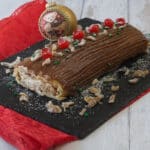
Tronchetto Di Natale (Italian Tiramisu Yule Log)
This Tronchetto di Natale is the Italian holiday version of a Yule log. A traditional Christmas dessert I discovered in the La Cucina Italiana archive from the 1970s, this recipe has become a holiday staple. Inspired by this classic, I created a reproduction using a Genovese sponge cake as a light base, a creamy mascarpone filling, and a decadent maron mousse frosting.
Servings 10 people
Calories 643kcal
Equipment
Ingredients
Swiss rolls sponge
- 4 fresh eggs
- ¾ cup sugar
- ½ cup flour
- 1 pinch salt
Filling
- 4 fresh eggs separated
- 4 tablespoon sugar
- 17 oz Mascarpone
Decoration
- 17 oz chestnut cream
- 5 candied cherries
- 16 oz caramellized orange peels
Instructions
Sponge cake
- Set up a bain-marie by placing a heatproof bowl over a pan of simmering water, ensuring the water does not reach a boil or touch the bottom of the bowl.
- Whisk the eggs and sugar in the bowl continuously until the mixture is thick, pale, and has tripled in volume.
- Whisk vigorously until you can form a ribbon trail on the surface.
- Remove the bowl from the heat and gently fold in the sifted flour, salt, and vanilla essence with a whisk, using slow movements to maintain the air in the batter.
- Spread the mixture evenly onto a baking tray lined with parchment paper.
- Bake in a preheated oven at 200°C (390°F); since the layer is very thin, it will cook rapidly, usually in about 10 minutes.
- Remove the sponge with the parchment paper from the baking tray and roll it immediately while still warm to set the shape so it doesn't break.
Mascarpone cream
- Prepare the filling by first whisking the egg yolks with sugar until pale and creamy.
- Gently fold in the mascarpone until smooth.
- In a separate clean bowl, whisk the egg whites until stiff peaks form.
- Gently fold them into the mascarpone mixture to create a light, fluffy cream.
Put it together
- Unroll the cooled sponge and spread the mascarpone cream evenly across the surface.
- Roll the sponge back up tightly; if you prefer, you can lightly brush the sponge with orange liqueur, though I skip this for large family gatherings to keep the dessert child-friendly.
- Refrigirate for a couple of hours to firm it up
- Frost the exterior with the marron mousse, using a fork to create textured lines that mimic the look of tree bark.
- Garnish with candied cherries and caramelized orange and lemon zest, then refrigerate for several hours to allow the flavors to meld and the structure to firm up.
Video
Nutrition
Calories: 643kcal | Carbohydrates: 94g | Protein: 9g | Fat: 25g | Saturated Fat: 15g | Polyunsaturated Fat: 1g | Monounsaturated Fat: 1g | Trans Fat: 0.01g | Cholesterol: 179mg | Sodium: 122mg | Potassium: 93mg | Fiber: 3g | Sugar: 66g | Vitamin A: 899IU | Vitamin C: 5mg | Calcium: 158mg | Iron: 2mg
