

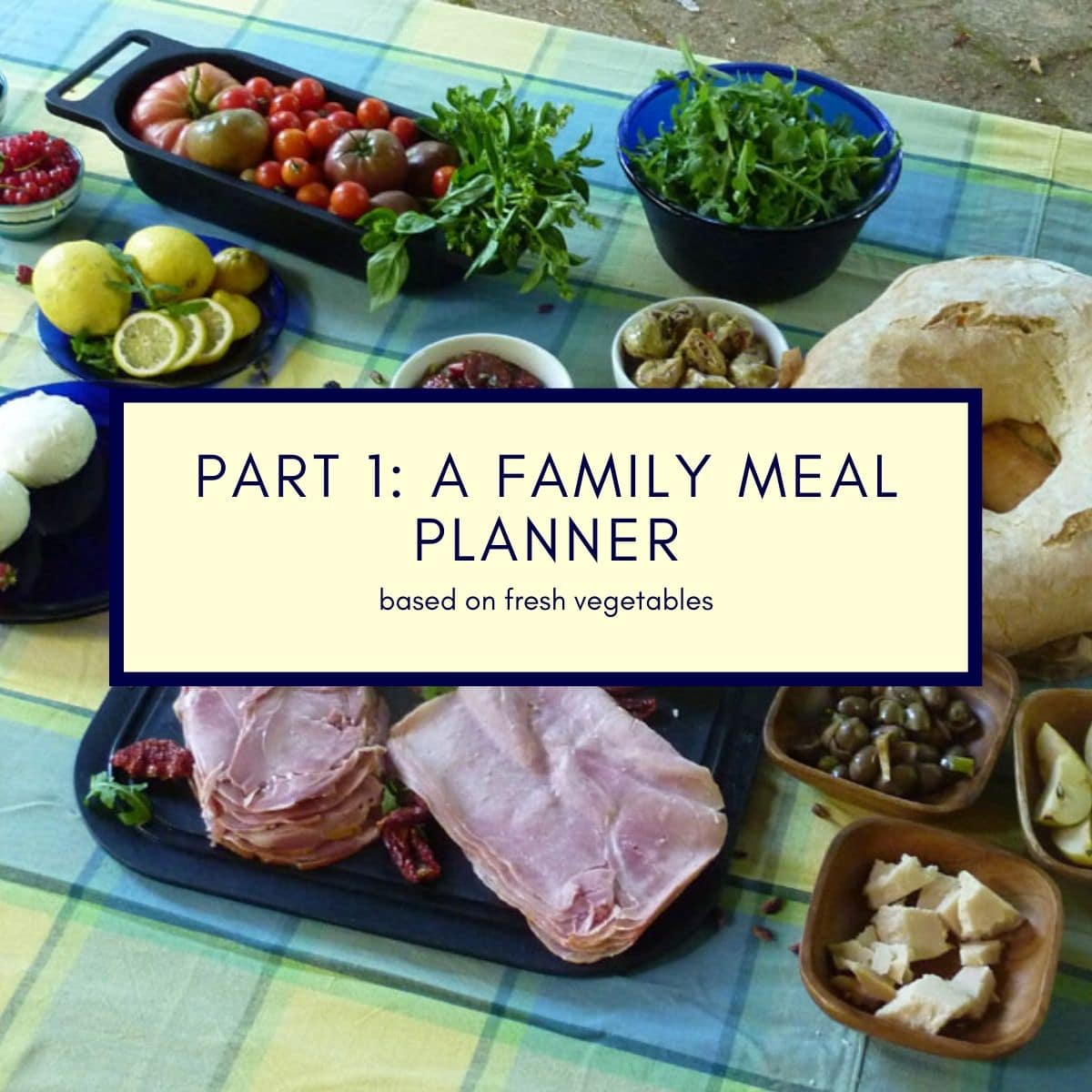
As an Italian, I refuse to plan my weekly meals in advance and go to the supermarket with a rigid shopping list. I only buy the vegetables that look good at the market, then I decide what to cook on the day. This is how I organize my family meals, and it takes less time than writing a menu.
Jump to:
While my meal schedule was more flexible when I was single, as soon as I started a family, preparing three meals per day became a challenge.
Especially when you move out of the city into the countryside, daily shopping becomes too time-consuming.
With time I created this system, and it has worked perfectly for 25 years.
My boys grew up appreciating fresh homemade meals and learned to cook while watching me.
Now they are the most popular with their friends.
They can come up with a great meal with a few fresh ingredients.
This post is Part 1 of a 5-article series: Organize your kitchen and eat healthily.
- Part 2: Italian Ingredients: A Comprehensive Guide
- Part 3: Once a Month Freezer Meal Prep
- Part 4: Cucina Povera: Zero Waste The Italian Way
- Part 5: How To Equip Your Kitchen If You Love To Cook Italian
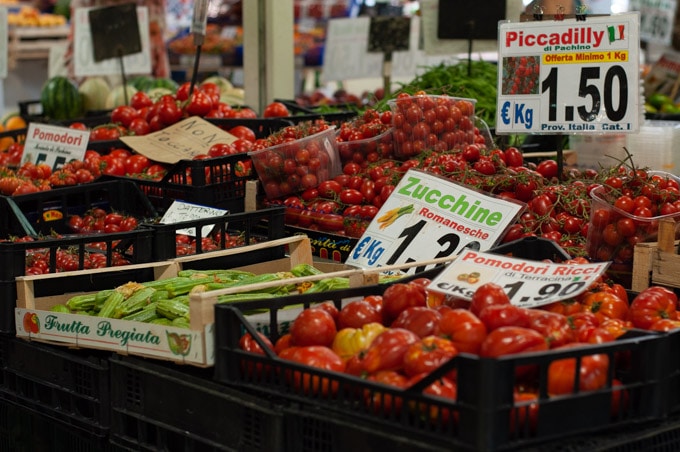
The market decides the menu: the "Whatever" Method
Italian weekly menus are never fixed.
They follow the day, the weather, what the market has, and whatever life brings.
This approach is not random, it comes from generations of rural life.
Every day people ate what was fresh from the garden, and in summer the fruit and vegetables were preserved to last through the winter.
Italy is one of the most biodiverse countries in the world, with around 7,000 species of edible vegetables, so every region has its own fresh ingredients to follow through the year.
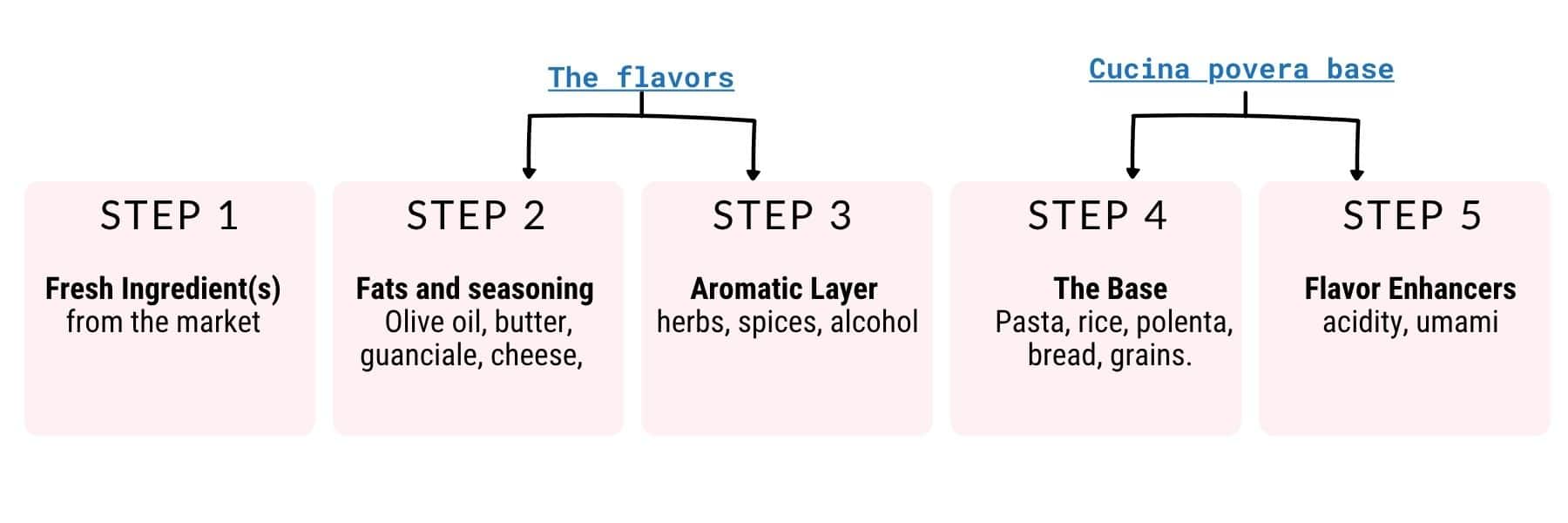
With this in mind, we can distinguish each meal built with five different components:
Italian cuisine was built around regional specialities:
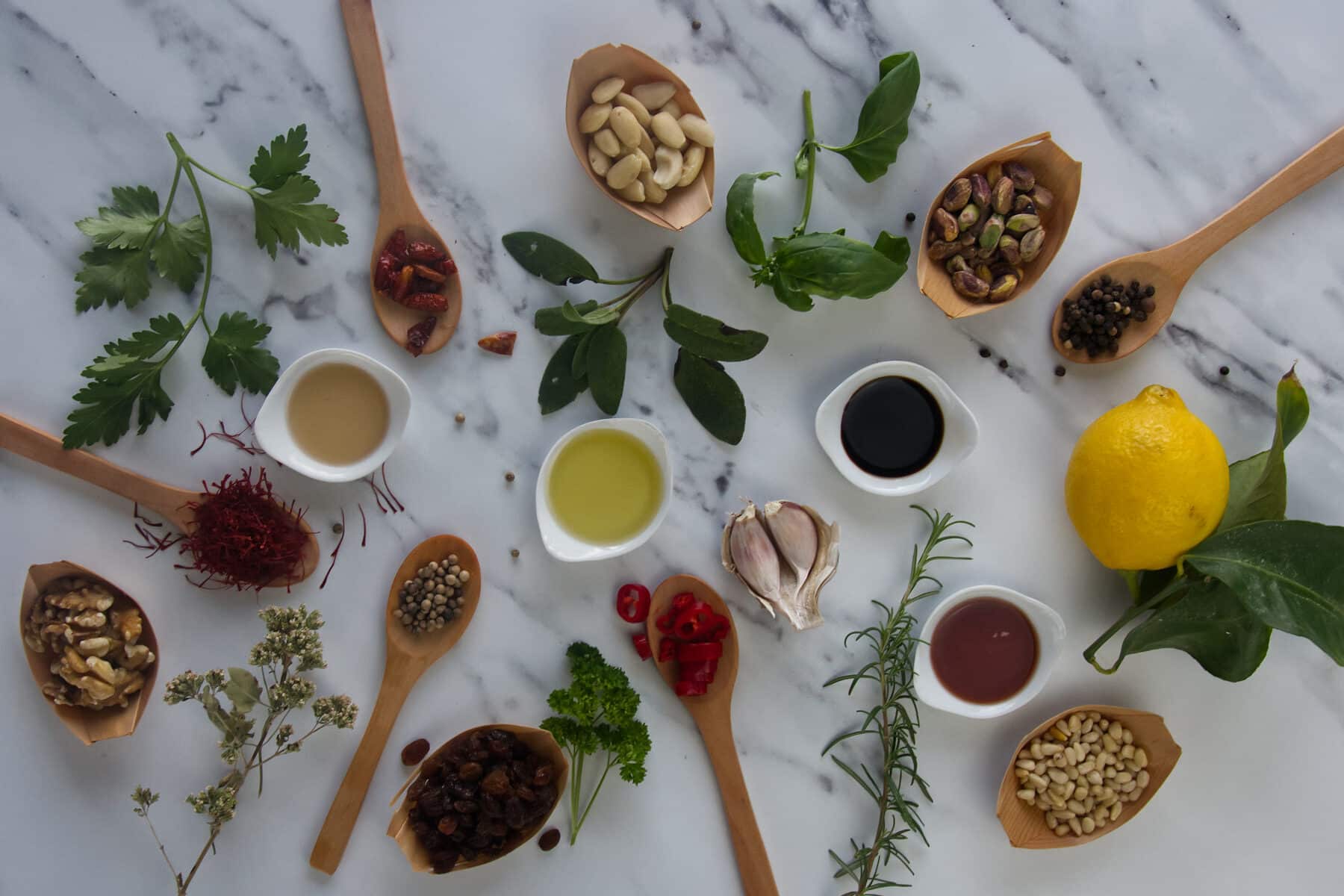
- The fat: butter in the North and a prevalence of olive oil in the South.
- The aromatic layer: balsamic vinegar in Emilia-Romagna, chilli pepper in Calabria and capers in Sicily.
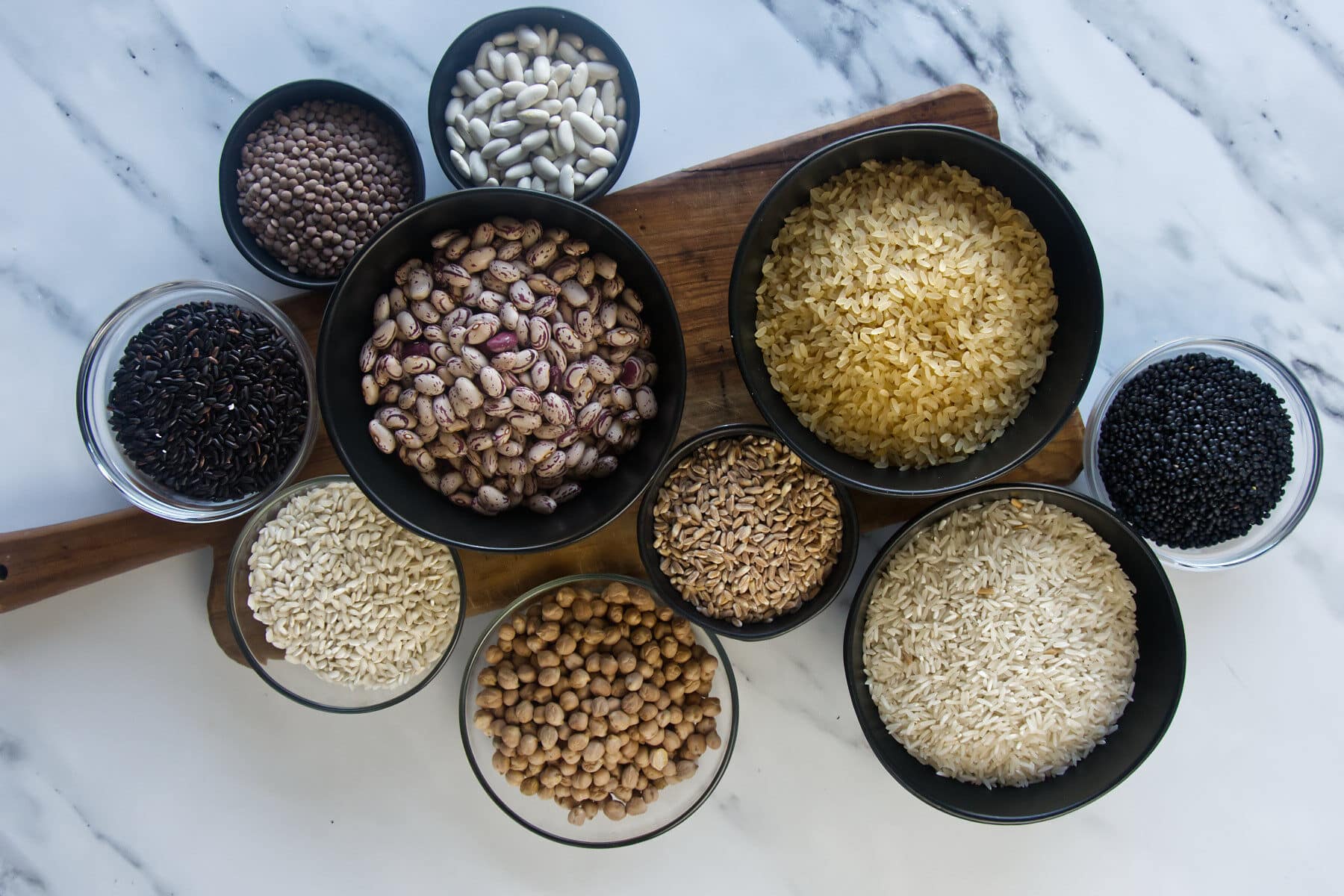
- The base: in the North, where corn and rice were produced, you have many recipes based on polenta and risotto, while in the South, where pasta was produced, you have more pasta recipes.
- The cheese: Parmigiano Reggiano in Emilia-Romagna and Pecorino in the rest of the South.
Fat, seasoning and the aromatic layers are the flavours, the base and the flavor enhancer are the cucina povera base.
When your pantry holds Steps 2 to 5, you are free to follow Step 1: the fresh ingredient you found at the market.
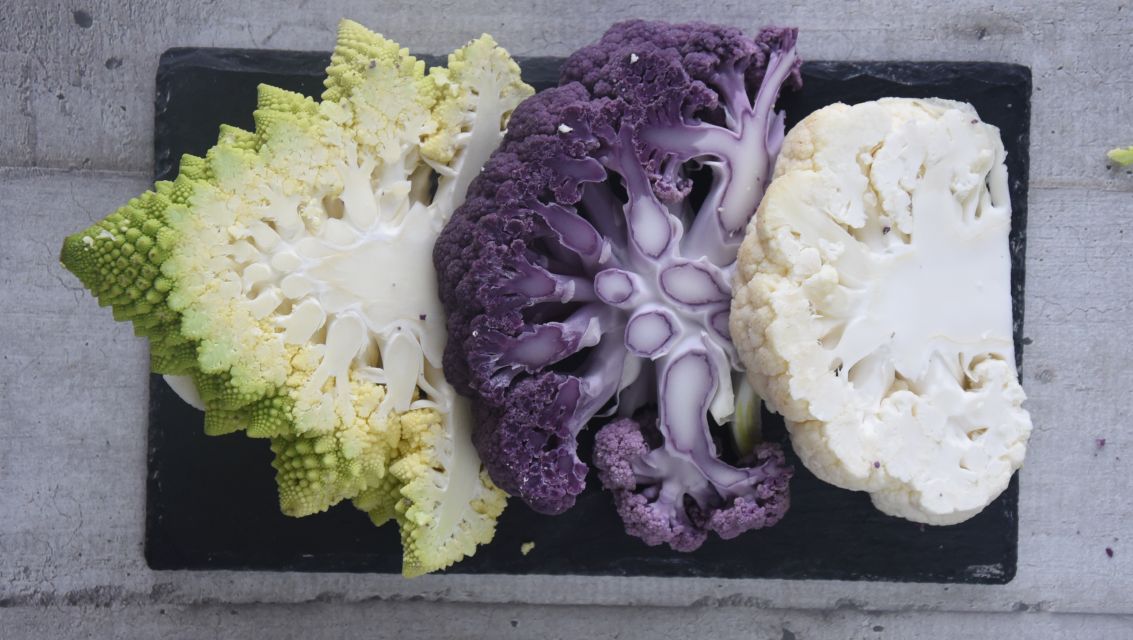
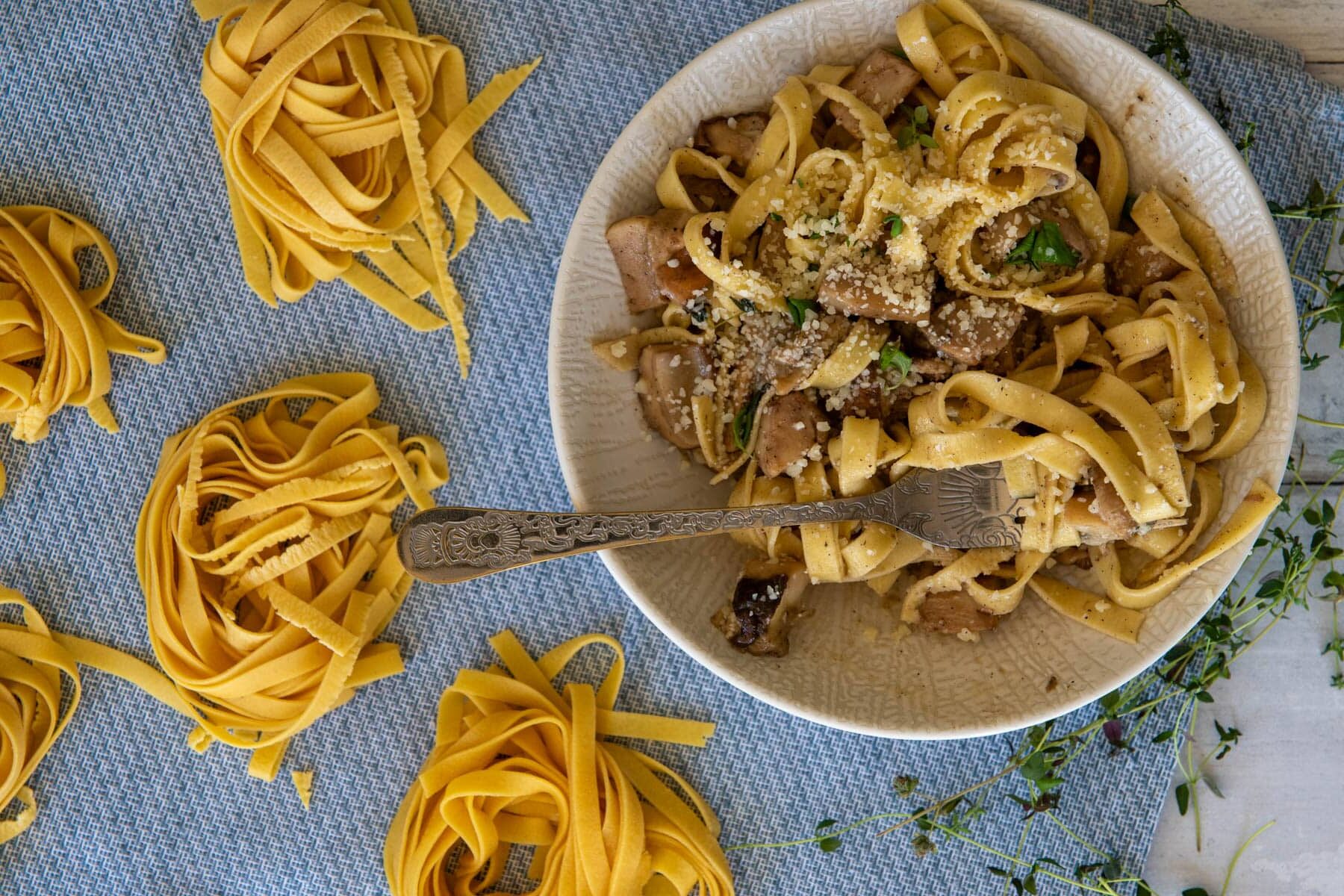
So, for example, the same porcini mushrooms are fried in butter and added to a risotto in the North, while in the South they are cooked in olive oil and added to pasta.
Fold them into eggs and it becomes a frittata.
Serve them beside meat and they become a side dish.
Same fresh ingredient, same flavours, different base, different meal.
You can find the vegetable combinations I use most in 20 Italian Vegetables Combinations You Can Use For Any Meal.
Once a week shopping list
The interesting aspect of this system is that the components from Step 2 to Step 5 have a long shelf life, so you can buy them once and stock them for the month.
So my shopping list is made of two sections:
General pantry items
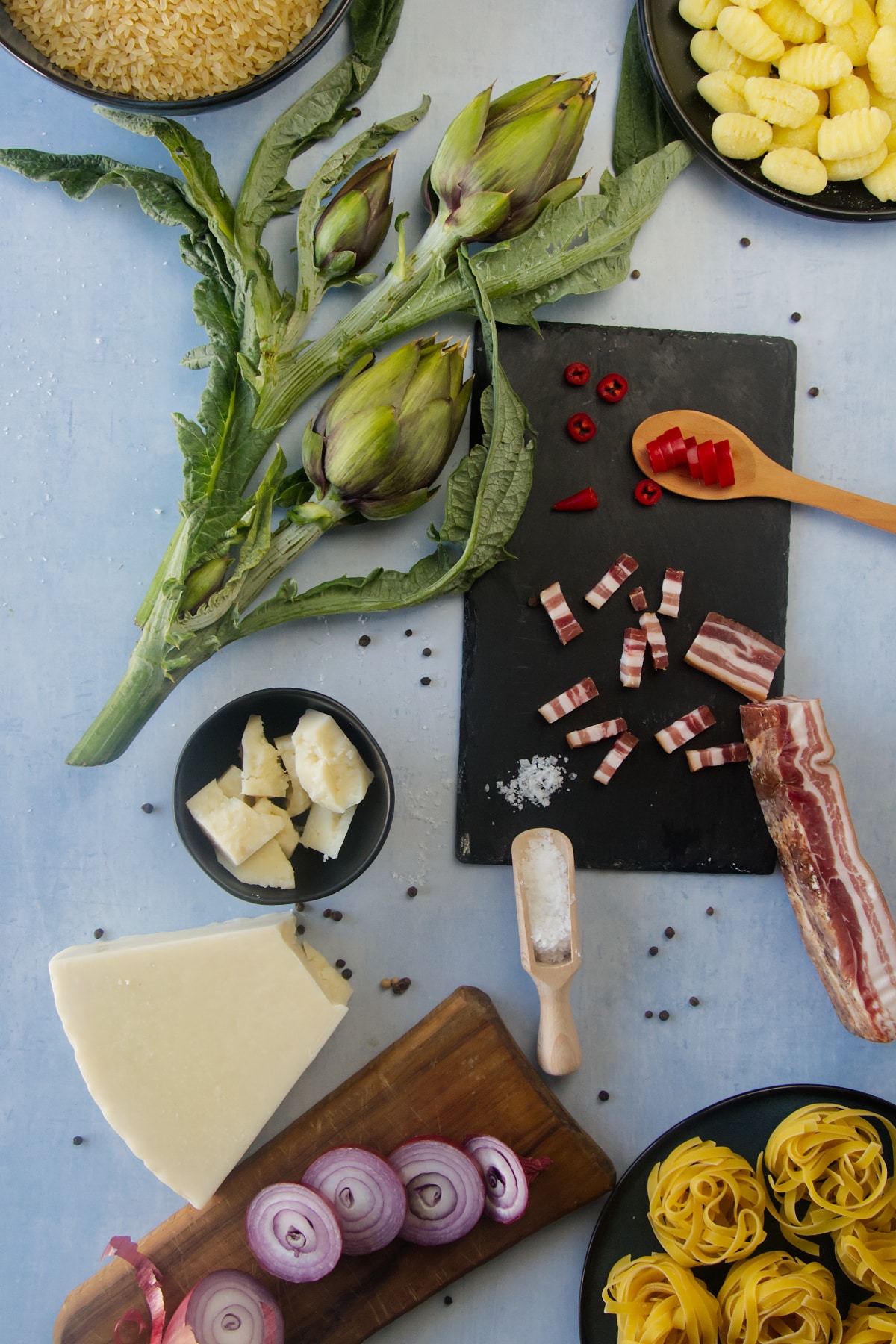
- Fats and seasoning (Step 2): olive oil, extra virgin olive oil, butter, salt, stock cubes
- Aromatics (Step 3): dried herbs, spices, chilli pepper, wine, liqueur
- Base (Step 4): pasta, rice, pulses, flours, polenta, bread
- Flavour enhancers (Step 5): vinegar, preserved tomatoes, anchovies, capers, preserved vegetables, tuna, mustard, mayonnaise
- Baking and desserts: sugar, chocolate, vanilla, yeast, baking powder, cinnamon, nuts, dried fruit, jams
- Breakfast and drinks: coffee, tea, cereals, oats, juice, long-life milk
Fresh food (Step 1 and the freezer)
- Fruit and vegetables, bought fresh
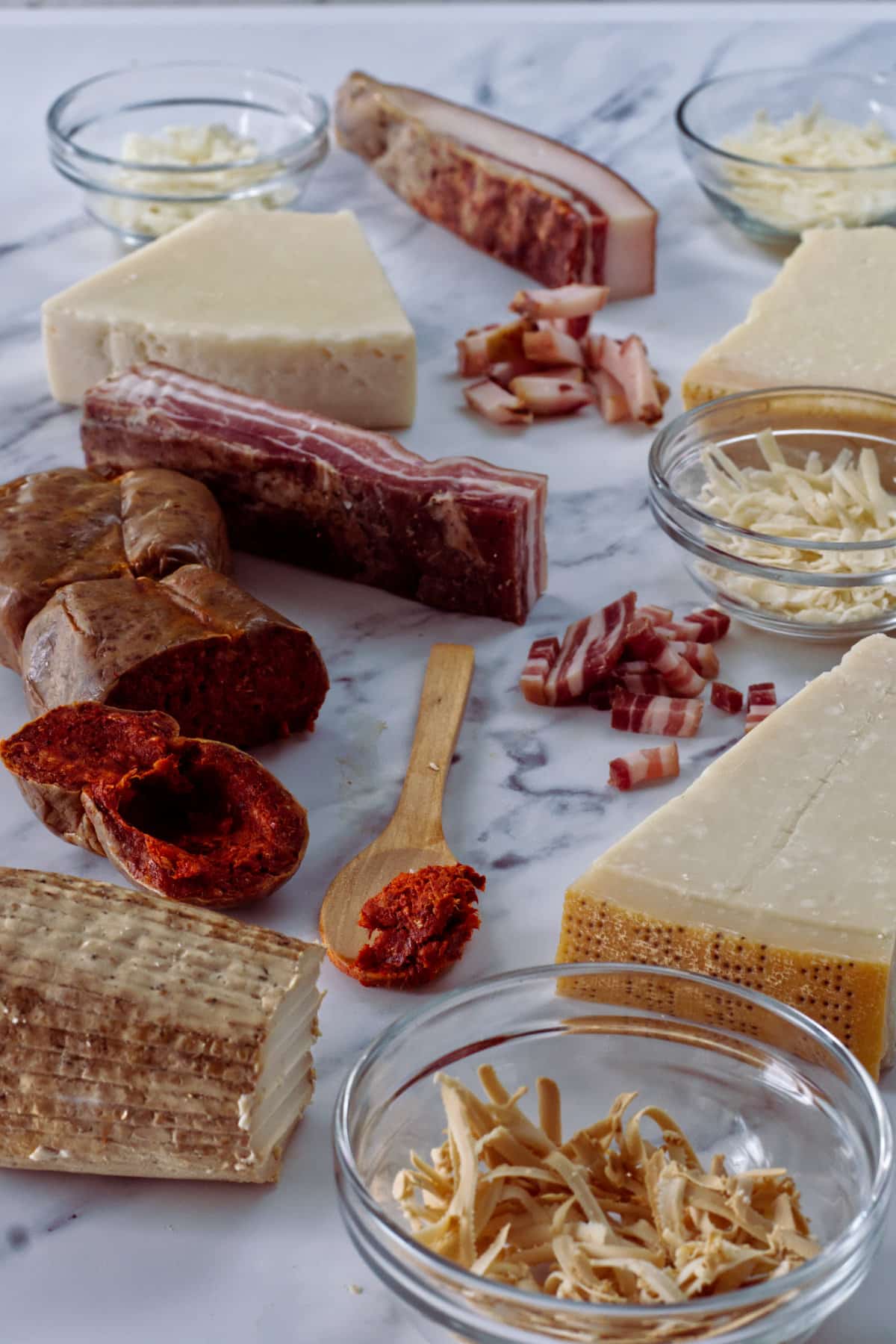
- Meat, fish, cheese, butter, milk, cream, yoghurt, eggs and charcuterie (ham, prosciutto, salami), fresh or frozen
Meat and seafood are part of the fresh component, but they do not need to be bought every day.
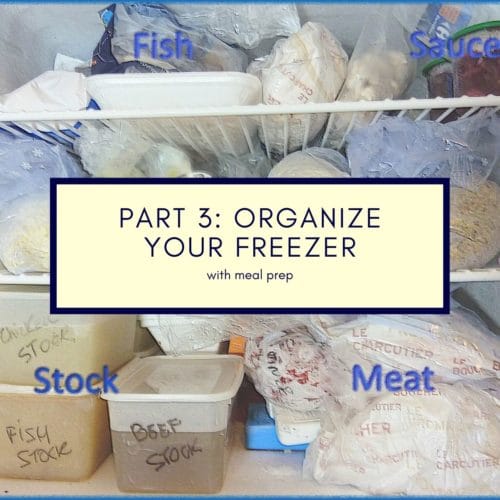
I buy them once a week and freeze them in portions, so they are ready whenever the vegetables decide the dish.
How I do it is in Part 3: Once a Month Freezer Meal Prep.
If you plan to go shopping only once a week, you need to sort out:
- your needs for a week's or a month's supply of your general pantry items;
- what you already have in your pantry, so you fill up your supply with the items you are missing.
To help you out, I keep two printable shopping lists with my favourite brands:
- Italian flavours shopping list for Steps 2 and 3
- Cucina povera shopping list for Steps 4 and 5
Use them as a starting point and add your other favourite ingredients. For the herbs and spices, see 36 Essential Herbs And Spices Used In Italian Cooking.
How to plan a weekly menu using fresh produce
So instead of planning the meals for the entire week upfront, this is how I organize my kitchen.
| The plan | Weekly menu planning | Day by day menu planning |
|---|---|---|
| Before shopping | Choose the recipes for the week and write the list from them | 1. Check the pantry and note what is running low |
| At the shop | Buy what is on the list, even when it looks old and sad | 2. Buy the vegetables that look good that day, plus meat and fish for the freezer |
| During the week | Follow the menu | 3. Sort the vegetables by how long they keep |
| Each day | Cook the dish that was planned | 4. Pick the next vegetable, decide what you want to eat, and reach for the base and the flavours in your pantry |
- Check the pantry. The fats, the aromatics, the base and the flavour enhancers are already in the cupboard, so I only note what is running low. This is the whole shopping list before the market.
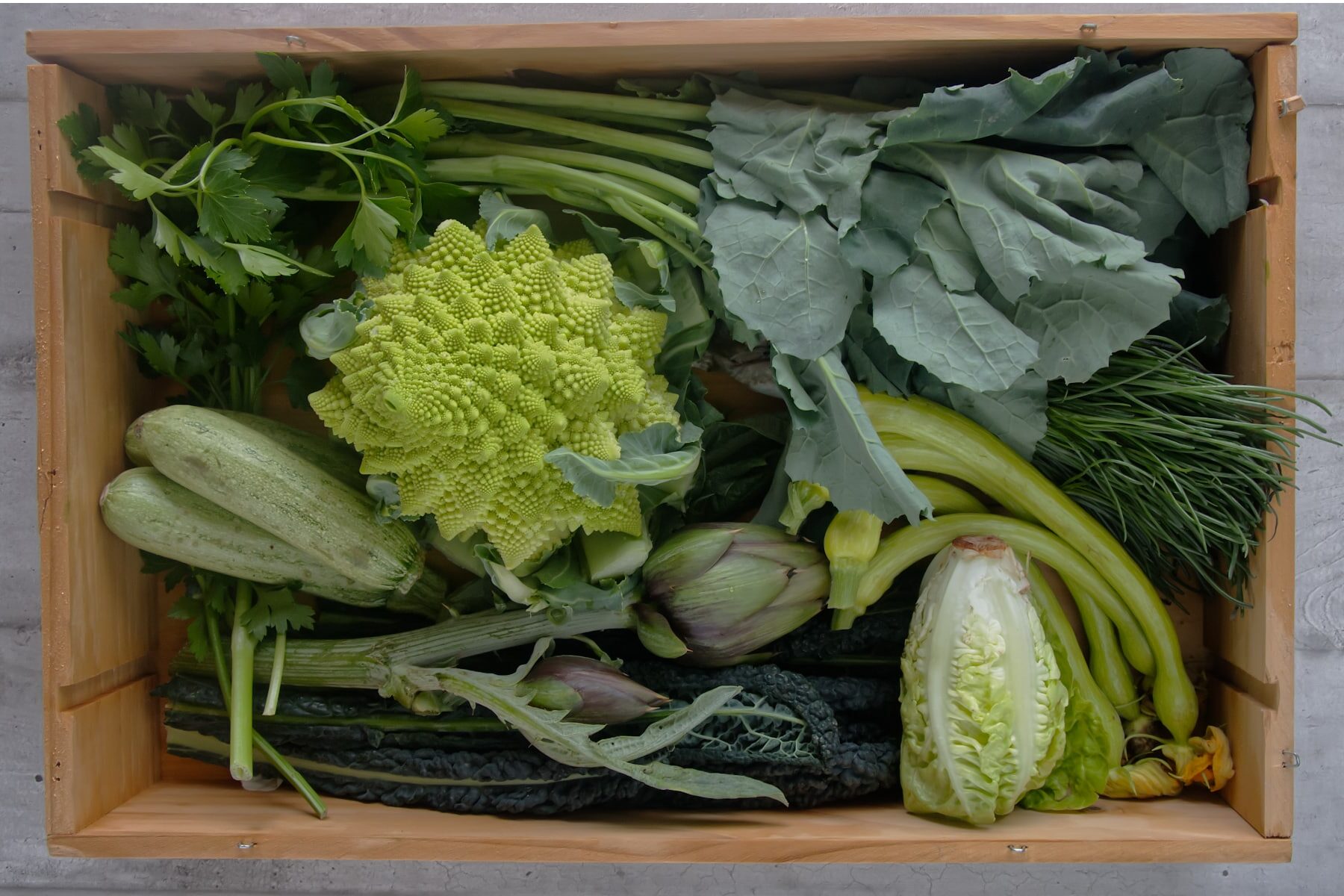
- Buy what looks best. At the market I buy the vegetables that look freshest that day, not the ones a recipe asks for. I buy enough for the week, plus the meat and seafood for the week, which go straight in the freezer in portions.
- Sort the vegetables by how long they keep. Back home, the ones that wilt first go to the front of the week and the ones that keep go to the end: leafy greens first, then tomatoes and courgettes, then roots and cabbages last.
- Decide each day. In the morning I look at which vegetable needs to be used, I decide what to have for dinner, I defrost any meat or fish needed (more if someone is coming for dinner), and I pick the base and the flavours from the pantry.
N.B. As a rule of thumb, I store each vegetable the way the shop stored it: in the fridge if it was in the chiller, out of the fridge if it was on the stall.
A real week from my kitchen
This is how the vegetables of one shop turn into the week's meals, in the order they keep:
- Leafy greens go first, as a side dish to a roast. I stir-fry the spinach with garlic and anchovies for the umami, with a side of potatoes.
- Zucchini become a pasta sauce, like my pasta with zucchini and ricotta.
- Tomatoes become a red pesto with basil that lasts the week, for pasta or on a bruschetta.
- Broccoli become pasta and broccoli.
- Onion, celery and carrots go into a stew or a ragù.
- Endive is grilled to serve on a pizza or as a side to meat.
- The leftover vegetables all go into a frittata.
- At the end of the week, pasta with potatoes empties the fridge.
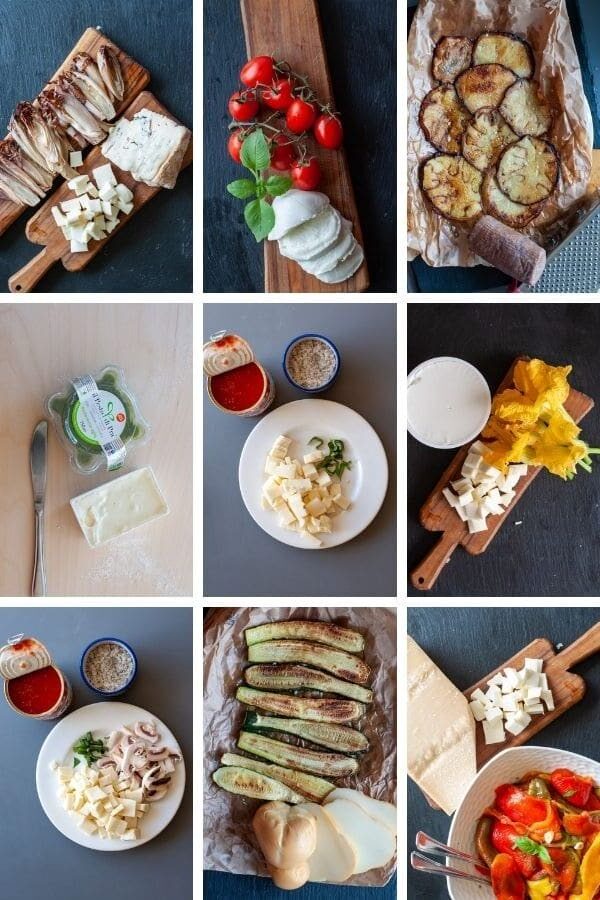
For vegetable and cheese combinations that work as a pizza topping but also as a pasta or risotto sauce, see my list of pizza toppings with fresh vegetables.
Our typical day looks like this, and you can adapt it to your family routine. Sunday is the exception, when we sit down to the full Italian Sunday family lunch.
- Breakfast: cereal, milk, juice, coffee or tea
- Lunch or dinner: protein, carbohydrates and vegetables
- Lunch or dinner: soup, pulses, charcuterie
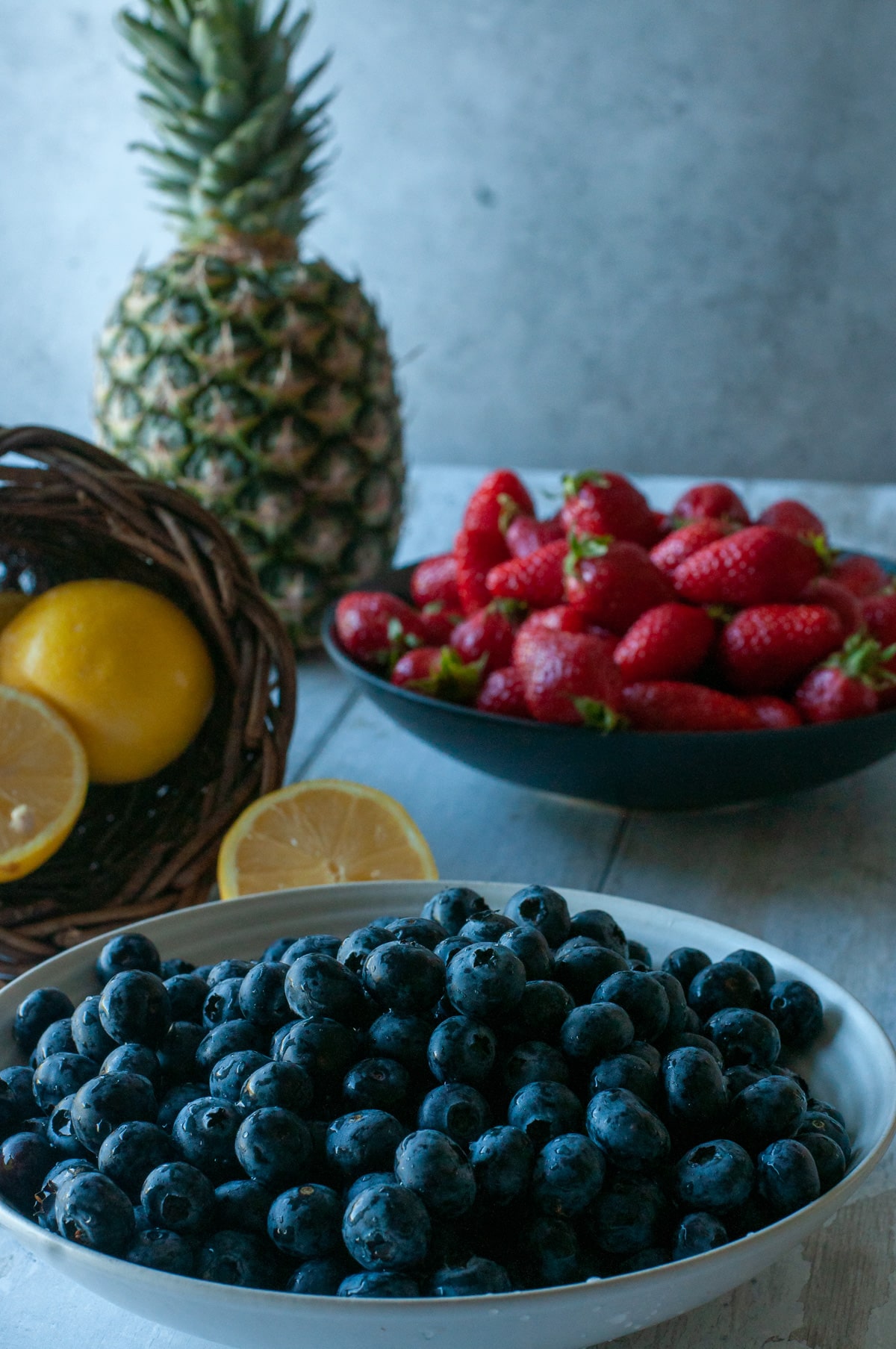
- Snack: fruit or dessert
In Italy, dinner is much lighter than lunch, as we tend to eat late and we would rather go to bed with a lighter stomach.
Children are usually back home for lunch, and stores are closed at lunchtime.
However, office life has changed our routines and adapted our meals to the new schedule.
I still prefer eating light in the evening to get a good night's sleep.
Questions
How do I plan a weekly menu using fresh produce?
It depends. If you live in a city and walk past a market every day, the market stall is what will give you the inspiration. If you go shopping once a week, buy vegetables with a different shelf life so they last through the week: leafy greens first, then tomatoes and courgettes, then roots and cabbages last.
Do Italians plan their meals for the week?
Normally not. We like to get inspired daily, based on our mood, the weather, what the market has, and daily life events.
How often do Italians go food shopping?
Sometimes daily. As most of us live in the city, we often stop at the market on our way back home. Market stalls are fascinating!
What should always be in an Italian pantry?
The staples that keep for a month: extra virgin olive oil, preserved tomatoes, pasta, rice, pulses, anchovies, capers and the seasoning. The full list, with the brands I buy, is in Part 2 of this series.
Can I freeze meat and fish and still eat fresh?
Yes, this is how the method works. Carbohydrates keep for months in the cupboard, meat, fish and cheese go in the freezer, and only fruit and vegetables have to be bought fresh, so they are the only thing that decides the week.
This system works with any cuisine, not only Italian. If you cook Mexican, Chinese, Japanese or Indian food, keep the same five steps and add your favourite ingredients to the pantry list.
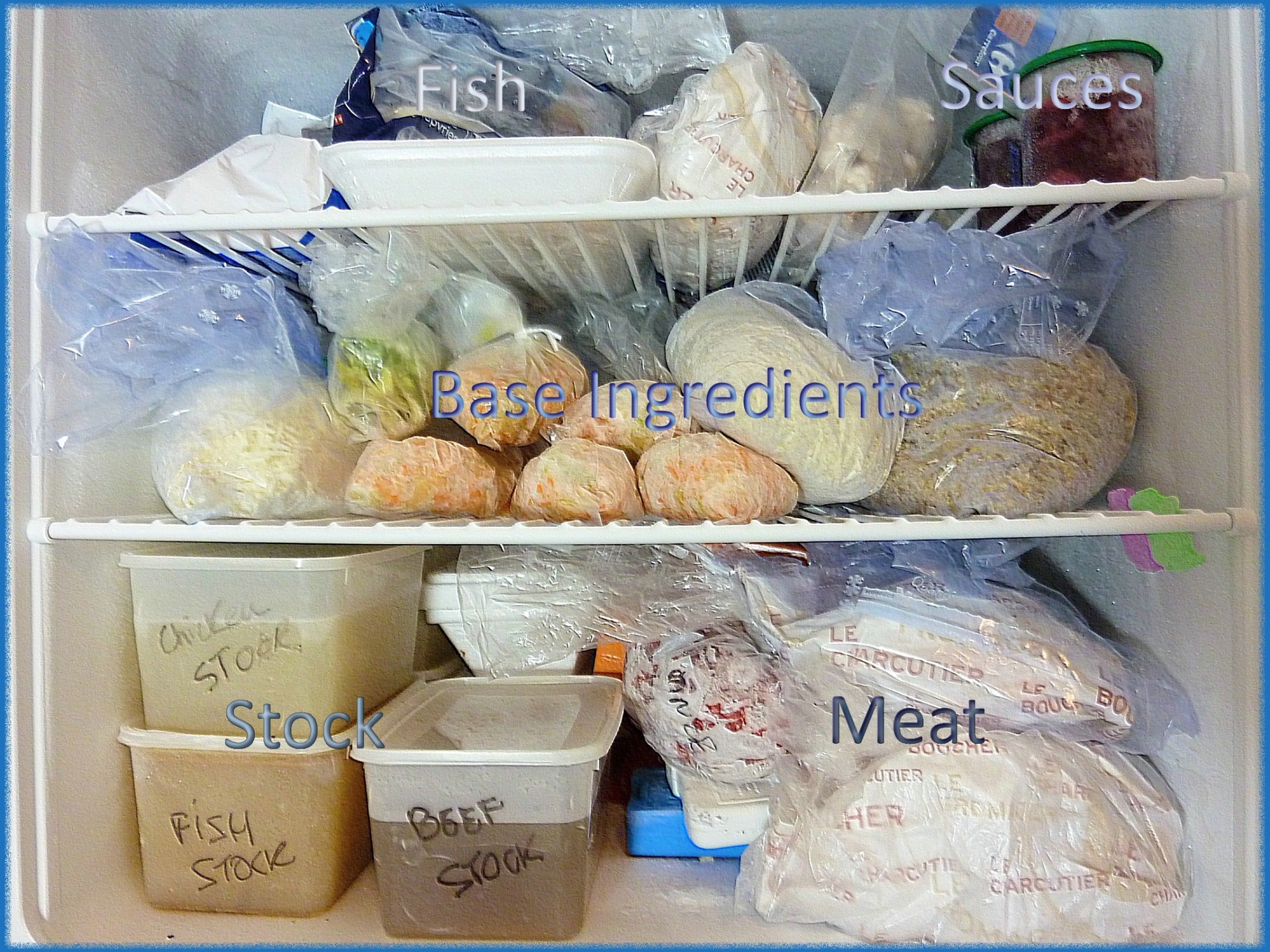
For ideas for a comprehensive shopping list, you can check my next article: Part 2: Italian Ingredients: A Comprehensive Guide (plus my favourite brands and a printable shopping list)
Hope you find this article helpful, please if you have any questions, write them in the comments below and I will be happy to respond and help. You can find delicious ideas if you FOLLOW ME on Facebook, YouTube, Pinterest and Instagram or sign up to my newsletter.
Sandra
Th ank you Laura
Laura
You are very welcome
Célyne Gardère
Thanks for bringing a little corner of home to Bangkok! Grazie, Laura
Laura
Hope you are doing well
Helen Porter
Some great ideas here, Laura. I hate throwing food away too!
I am really enjoying your series of posts.
Stay well! xox
Laura
Thank you Helen, join us soon!